
Finding Clayton County Residents
Start any Clayton County residents directory search from the strongest fact you hold. An address leads straight to the parcel roll. A full name opens doors elsewhere. The assessor, court party index, deed index, or a professional license record can each carry that name. For an older address, try directory catalogs, newspapers, census schedules, and deed books. Every source proves something different, and knowing the difference saves wasted effort. The assessor names a titled owner, not everyone under the roof. A court hit identifies a party to a filed case, never a current address. Georgia My Voter Page confirms one voter's registration once identity details are entered, but it cannot browse a street for you.
Anchor a person with two independent facts before merging records into one identity. A middle initial, a spouse, a parcel number, a case number, a business control number, or a shared date can pull same-name Clayton County residents apart. Try spelling variants too. Reversed name order matters as well. If the trail runs older than Clayton County's 1858 creation, move to Henry or Fayette County records rather than assuming the person disappeared.
- Search Clayton Public Access by owner name, street address, or 12-digit parcel number.
- Compare the mailing address with the situs, or physical, address before drawing a residence conclusion.
- Use the current owner's name in the GSCCCA deed index and confirm the legal description or book and page.
- Check the relevant court, voter, license, business, or historical source for a second independent match.
- Ask the custodian for a terminal search or narrowly described existing record when the web portal stops.
Clayton County Directory Custodians
No single Clayton County office keeps a master list of who lives where. Each custodian holds one piece instead. The Board of Tax Assessors tracks parcel ownership and address evidence. The Clerk of Superior Court files deeds, liens, and plats. That office also keeps Superior and Magistrate case records. Probate Court handles estates, guardianships, and marriage licenses. Elections records sit apart under separate Georgia rules. The Clayton County street directory walks through the full address chain. This map shows where each piece begins.
Superior Court Real Estate Records
Clayton County Justice Center
Jonesboro, GA
770-477-3395
GSCCCA Search
Clayton Board of Tax Assessors
Property and tax records
Jonesboro, GA
Online and counter access
Clayton Public Access
Georgia Elections Division
Individual voter verification
Georgia statewide service
Identity details required
Georgia My Voter Page
Start With Clayton Property Records
A Clayton County lookup can start with a name or an address. Clayton Public Access is the best free first stop. Its basic and advanced searches handle owner name, address, parcel, sales, and map routes. Open a result. The parcel card shows the owner, mailing and situs addresses, values, exemptions, sales history, land, structures, sketches, appeals, assessment notices, pictometry, permits, and map links. Know the difference between the two address fields. The mailing address is where tax correspondence goes. The situs address marks the physical property. Neither one gives you a full household. Treat the parcel record as one piece of the residents directory puzzle.
| Search route | Best use | Important limit |
|---|---|---|
| Owner or name | Find parcels titled to a named person or entity | Same names require a parcel or deed check |
| Address | Find the physical parcel | Use the portal's standardized street spelling |
| Parcel | Open one precise tax record | Clayton uses 12 digits without hyphens |
| Advanced | Combine street, neighborhood, or land criteria | A ZIP field was not confirmed |
The official property and tax access screen shows the actual route residents encounter.
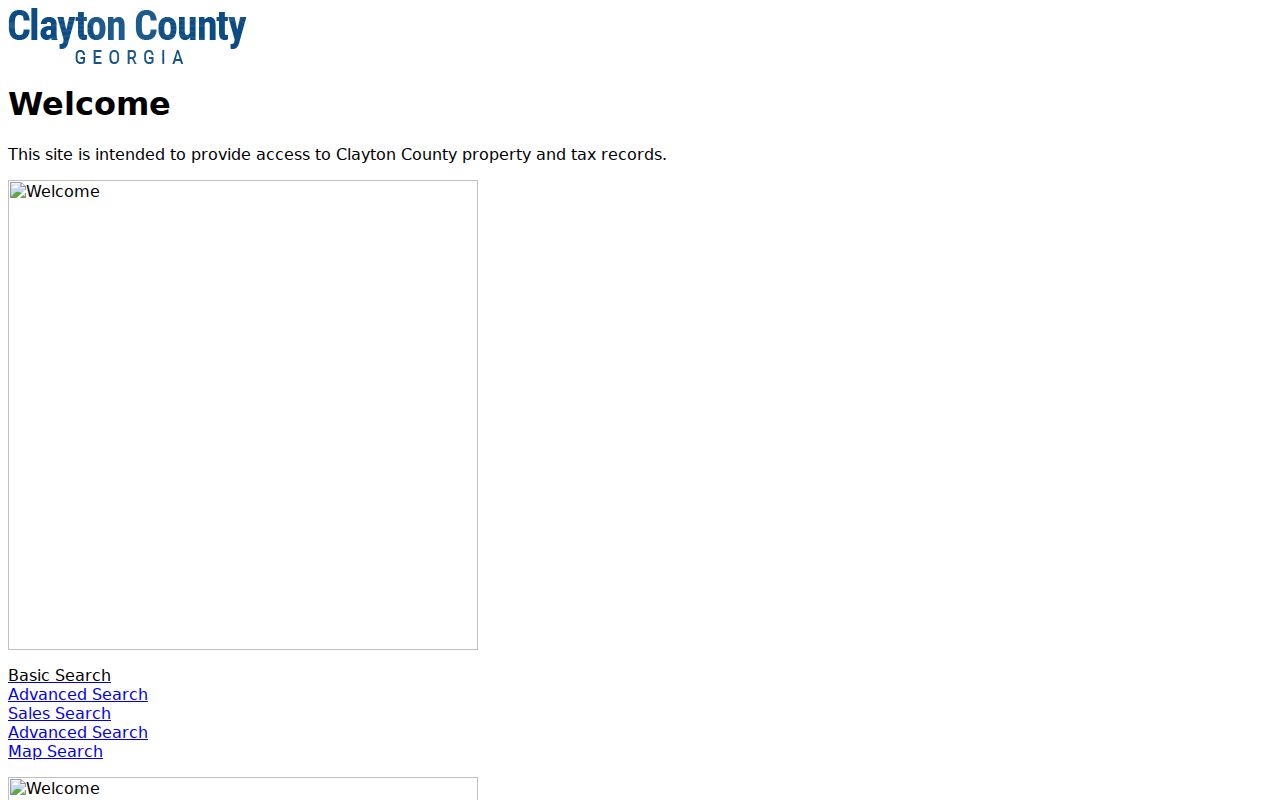
That landing page matters. It is the bridge from a street or owner name to the parcel card used in later Clayton County record checks.
Clayton Deeds Connect Names
The state deed hub brings several record systems onto one screen. Its statewide real-estate index covers deeds, security deeds, liens, plats, PT-61 transfer forms, UCC filings, and notaries. Georgia's standardized real-estate data reaches back to at least January 1, 1999. Clayton may hold older indexed material or historical additions. No accessible official page states the precise current online cutoff, so ask Real Estate Records about the oldest online and onsite grantor and grantee indexes before a long title search.
A grantor transfers an interest. A grantee receives it. Match the owner shown in the assessor's parcel record to a deed's party name, legal description, recording date, and book/page reference. Images and advanced functions may require an account. The courthouse terminal remains an important fallback.
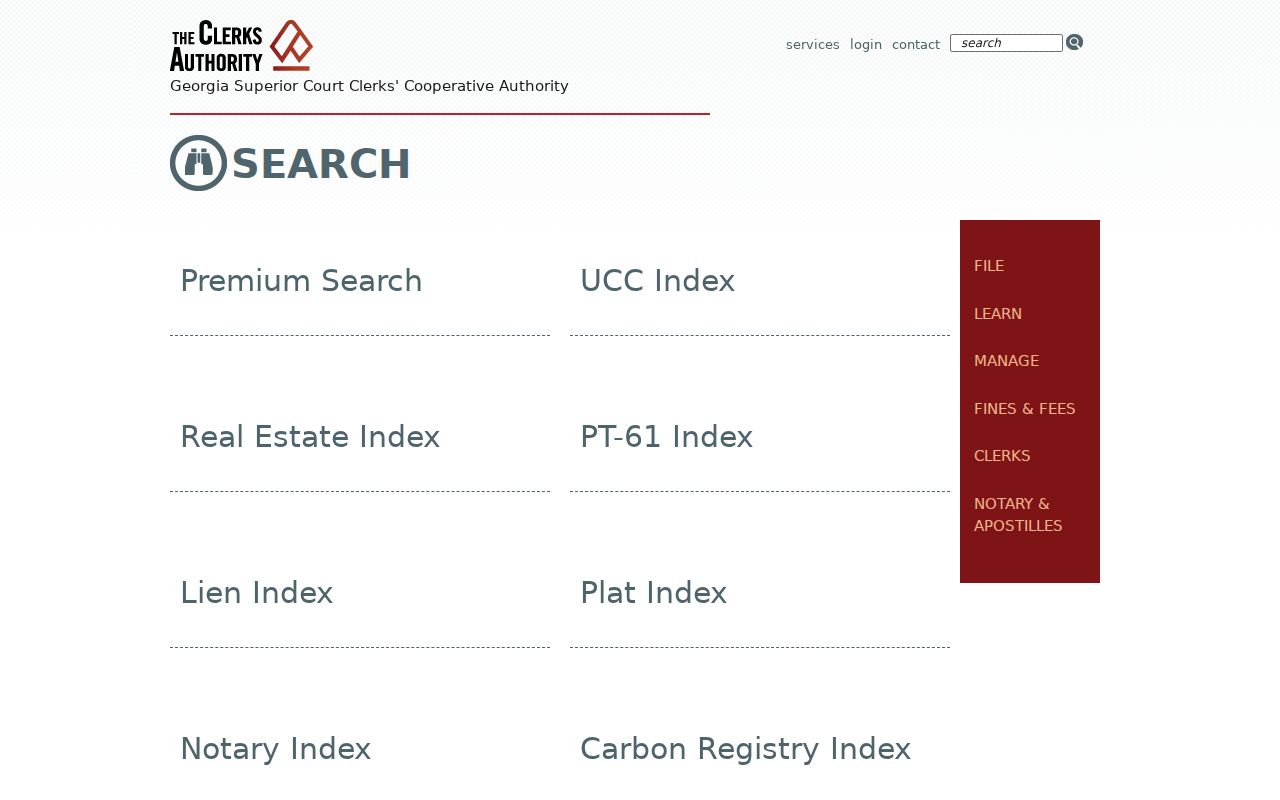
The index can tie a name to a legal interest in a parcel. It should not be read as proof that the person lives there.
Current Clayton County Directory Sources
A Clayton County residents directory is really a set of purpose-built official indexes. Each has its own keeper, its own access method, and its own boundary. Property records cover titled owners. Voter tools cover registered voters under election law. Deeds show parties to recorded instruments. Court indexes identify case parties subject to sealed and excluded categories. Business and license searches expose public professional or corporate facts. Those facts may point to a work address rather than a home.
| Source | Who It Lists | Keeper | Access |
|---|---|---|---|
| Property roll | Titled owners and mailing contacts | Board of Tax Assessors | Free web portal and office |
| My Voter Page | One verified registered voter | Georgia Secretary of State | Free identity lookup |
| Voter list | Lawfully released registered voters | Georgia elections officials | Paid request, protected fields removed |
| Real Estate Index | Parties to deeds, liens, and plats | Superior Court Clerk and GSCCCA | Index, account features, terminal |
| Court inquiry | Public civil and criminal case parties | Clayton court clerks | Free web index and terminals |
None of these is a master list. The Clayton County resident lookup sets out the safer one-person comparison method. Treat commercial finder products as unverified leads only, since they can merge stale or unrelated records, never as official proof.
Clayton Voter Records Differ
Georgia's My Voter Page answers one question at a time. You enter identifying details for a single voter. It returns that person's registration status, precinct, polling place, districts, and ballot details. That makes it a verification tool, not a Clayton County residents directory. It cannot browse a street or list households the way a street directory would.
For a broader view, the state sells a separately ordered public voter list. Under O.C.G.A. §§21-2-225 and 21-2-601, it may include voter names and residence addresses. That gives it some resident lookup value. Birth dates, Social Security numbers, and driver-license numbers stay out. Commercial use of the list is barred. The official voter verification screen shows the one-voter workflow in action.
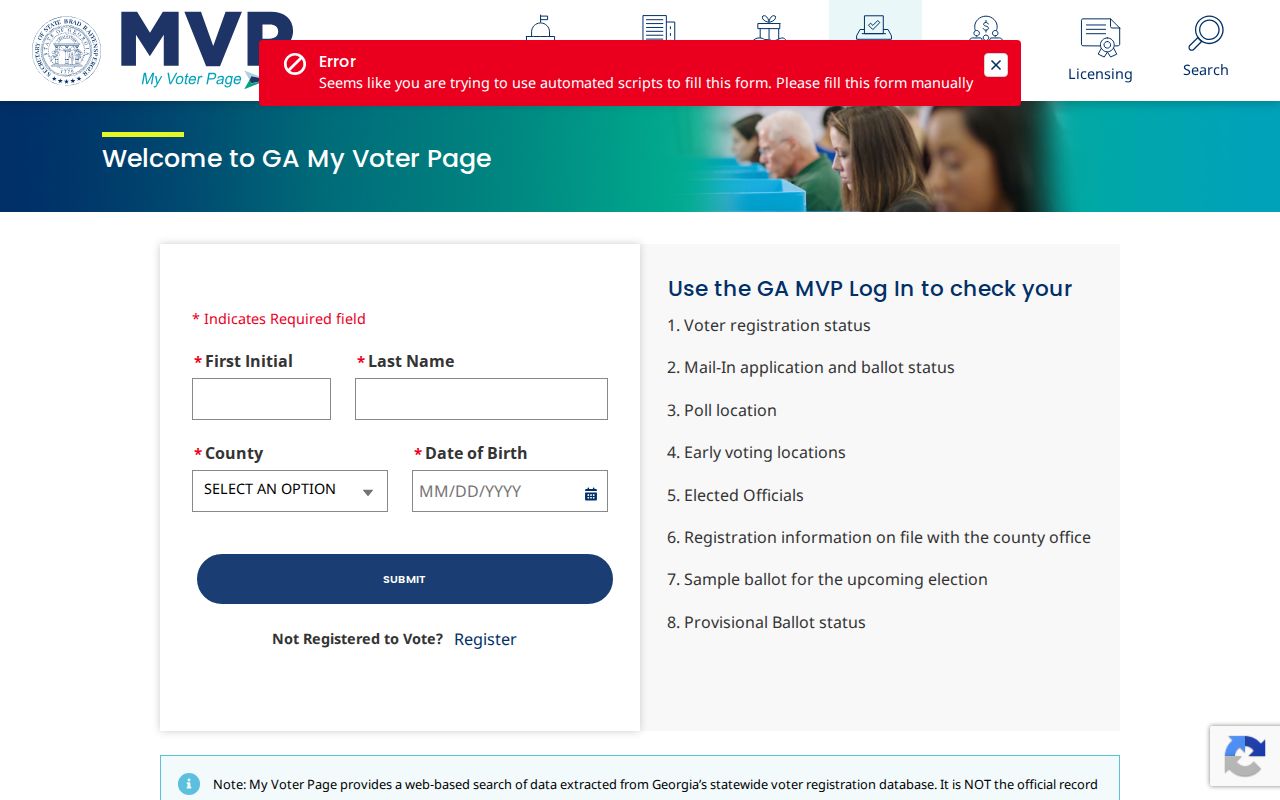
That gap keeps a verification portal from standing in for a block or street directory.
Clayton Court Search Blind Spots
The Clayton court inquiry reaches public Superior, State, and Magistrate records. It covers civil and criminal matters entered into the local system. Some material sits outside it. Adoption, juvenile, Probate, protective-order, sealed, and pre-JIS matters are all excluded. An empty result never proves a file is absent. Free viewing of public files is available at the Magistrate public-access terminals. Those terminals sit on the second floor of the Justice Center. The clerk can explain copy access there. The county court records screen carries the online name and case-number routes. Those routes serve a Clayton County residents directory search.
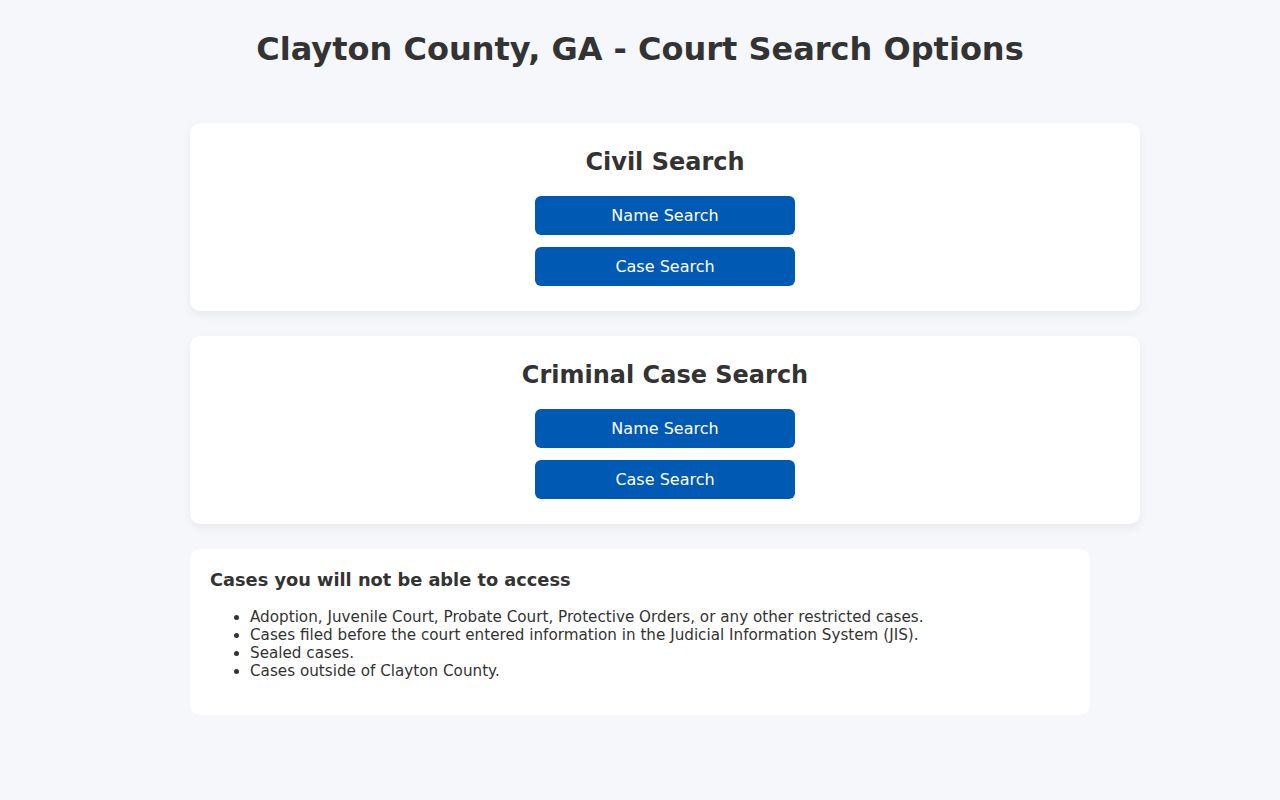
Two court entries can look identical at a glance. Before deciding they name the same resident, compare a case number, a middle name, or a related parcel or probate clue.
Clayton Vital Record Channels
Birth and death service comes locally from the Clayton County Health Department. That office sits at 1117 Battlecreek Road in Jonesboro. The Georgia Department of Public Health handles statewide requests. Online, mail, and office routes cover birth and death records from January 1919 forward. Marriage records fall within its stated coverage too. Probate Court is the fallback for county marriage licenses outside that state scope. Access rules differ by record type. Birth certificates go only to the registrant, qualifying family, or legal representatives. Certified death copies require a qualifying relationship or tangible interest. Any member of the public may request a plain-paper death copy. The Social Security number is redacted on that version. Georgia law sets no fixed year after which these records simply become public. The official request options separate the available channels and applications.
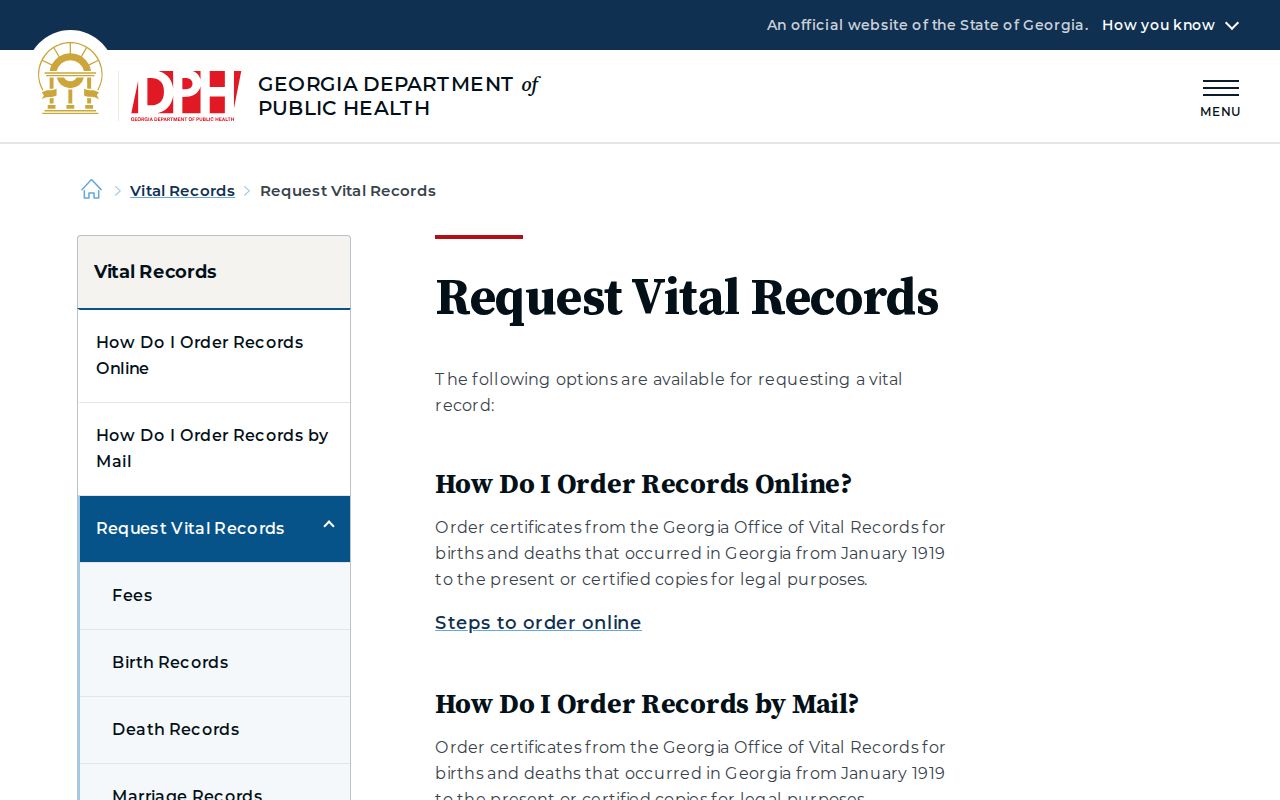
The screen is a request gateway, not an open index of Clayton County residents.
Open Records Beyond Clayton Portals
Records missing from county portals still have a route. The Clayton GovQA portal handles requests for existing county records. The Board of Commissioners Clerk serves as the designated Open Records Officer, yet a request must reach the office that created the material. A Forest Park or Riverdale city record belongs with that city. Municipal police records go to the police records unit. Under the Georgia Open Records Act, O.C.G.A. §50-18-70 et seq., an agency generally must produce responsive records or give a written timetable within three business days. A narrow description works best. Name the department, parcel or case, date range, desired fields, and electronic format. Agencies do not have to create a new compilation, so ask for estimated cost before production if the scope may be large. The official open-records portal provides submission and account-center routes.
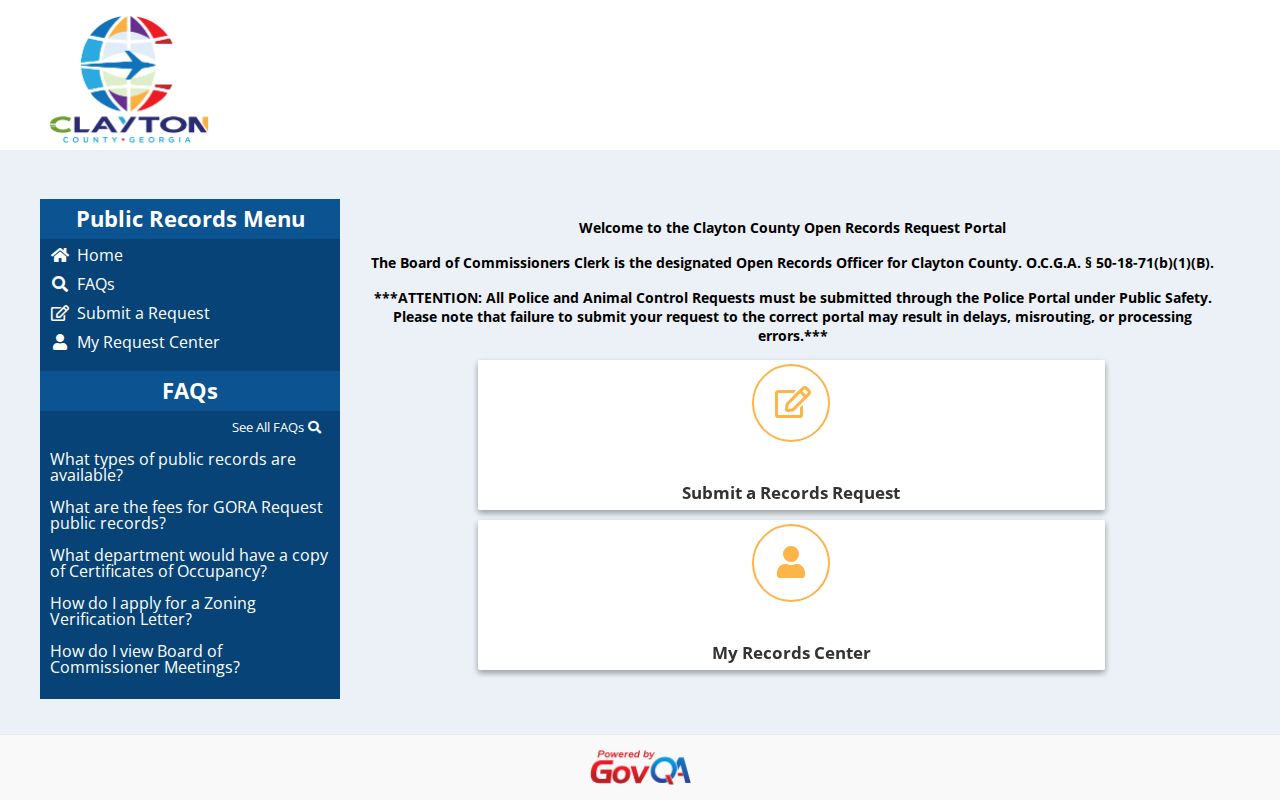
This fallback works best with precision. Name a record that already exists rather than asking staff to research a person.
Georgia Rules Shape Clayton Access
The Georgia Open Records Act frames access to records held by Clayton County. But more specific laws still control sensitive material. A prompt response is not instant production. Within three business days, the agency generally must provide the record, cite an exemption, or explain the timetable and expected cost. Search and retrieval fees may apply under the statute. An office need not answer broad research questions. It also need not build a spreadsheet that does not already exist.
Channels shape what a search sees. A web index may show only part of a record set. Some deed images and advanced GSCCCA tools require an account. Courthouse terminals reach public records onsite. Magistrate files can be viewed free at public terminals. Vital certificates follow identification and relationship rules. A city-created permit or police record must go to that city rather than the county portal. These distinctions keep a Clayton County residents directory search pointed at the actual custodian.
The Georgia Attorney General's open-government guidance explains the response framework. State and local agencies use it.
Guidance works better with a tight request. Name the office, record type, date range, and preferred electronic form.
Clayton Records Can Prevent Scams
A residents directory is a handy tool for testing a suspicious claim. So are the county's official indexes. The Clayton Clerk warns about jury-duty scams. Courts, police, and the sheriff never phone residents to collect a fine over missed jury duty. Hang up and call the Jury Division at 770-477-3408. An overpriced deed-copy offer can be checked against the clerk's own copy channel. GSCCCA's Filing Activity Notification System flags new filings on registered property. The clerk's index then confirms what was actually recorded.
Obituary details never prove a caller is family. Call a known relative yourself. Before paying a finder, search Georgia's official unclaimed-property portal for unclaimed money. Report suspected deed activity to Clayton Real Estate Records at 770-477-3395. Used this way, Clayton County records support personal safety. They do so without turning a resident lookup into an unsupported judgment about anyone.
Clayton Address Geography Matters
Forest Park, Jonesboro, Lake City, Lovejoy, Morrow, and Riverdale are Clayton County's six incorporated cities. Postal labels reach much farther. Rex, Ellenwood, Conley, and parts of Hampton, Stockbridge, College Park, or Atlanta mailing areas are all common here. Each of them can involve Clayton records. A Jonesboro or Riverdale mailing city does not establish city jurisdiction. Confirm the parcel's county and jurisdiction layer before requesting permits, licenses, or city records.
This is a common Clayton County residents directory trap. USPS labels organize delivery. Parcel maps identify county and municipal context. Census ZIP Code Tabulation Areas are statistical approximations. They are not USPS route boundaries. A ZIP code directory built on them can mislead.
Key point. Attach the 12-digit parcel number and the confirmed custodian to an address before relying on its postal city.
Two Archives Serve Clayton
Clayton County enjoys a rare research bonus. Both the Georgia Archives and the National Archives at Atlanta sit in Morrow. That puts them right inside the county. The state archive holds original records, genealogy material, and county and city histories. It also offers census tools and directory holdings. The federal branch covers court, agency, and military files. It adds immigration and naturalization material once catalog coverage is confirmed. For catalog work, start with the Georgia Archives research portal.
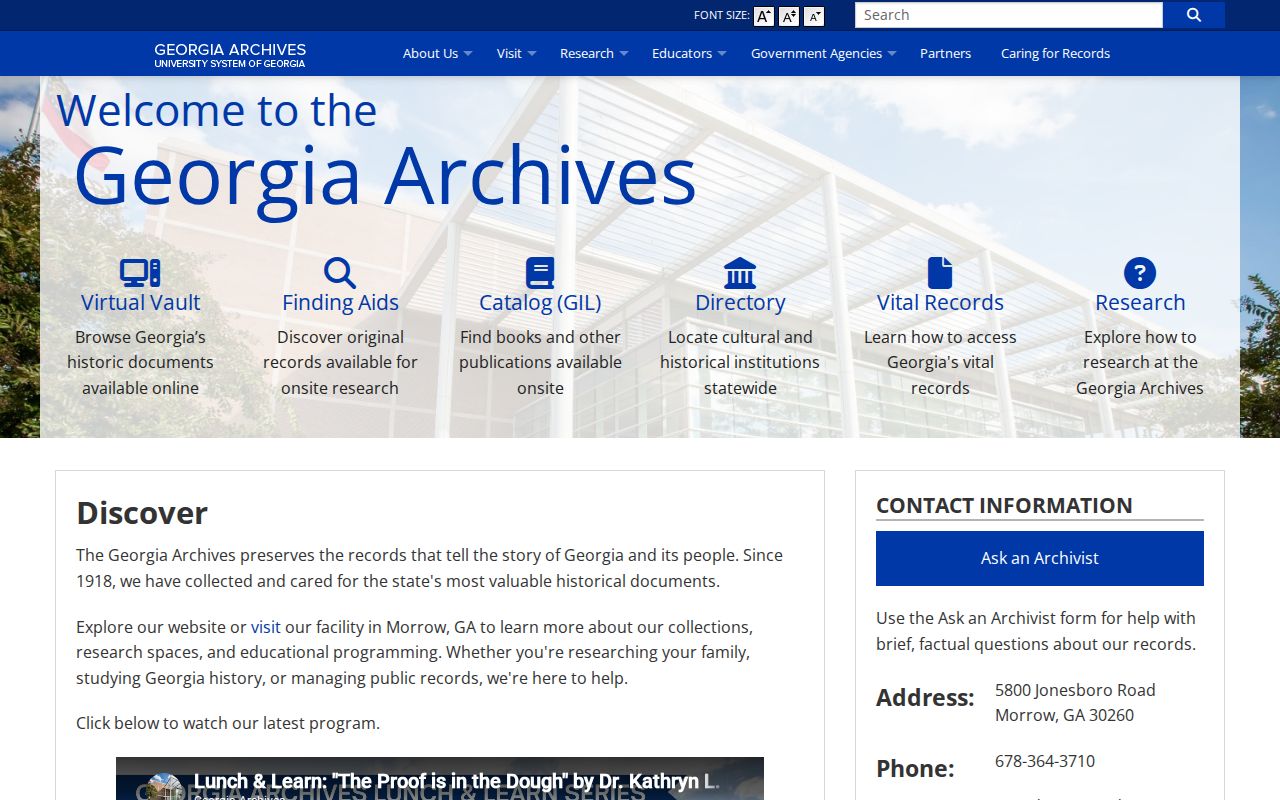
When a digitized index misses the record you need, an onsite visit is a practical fallback because both buildings are local. The National Archives at Atlanta offers a separate federal collection path.
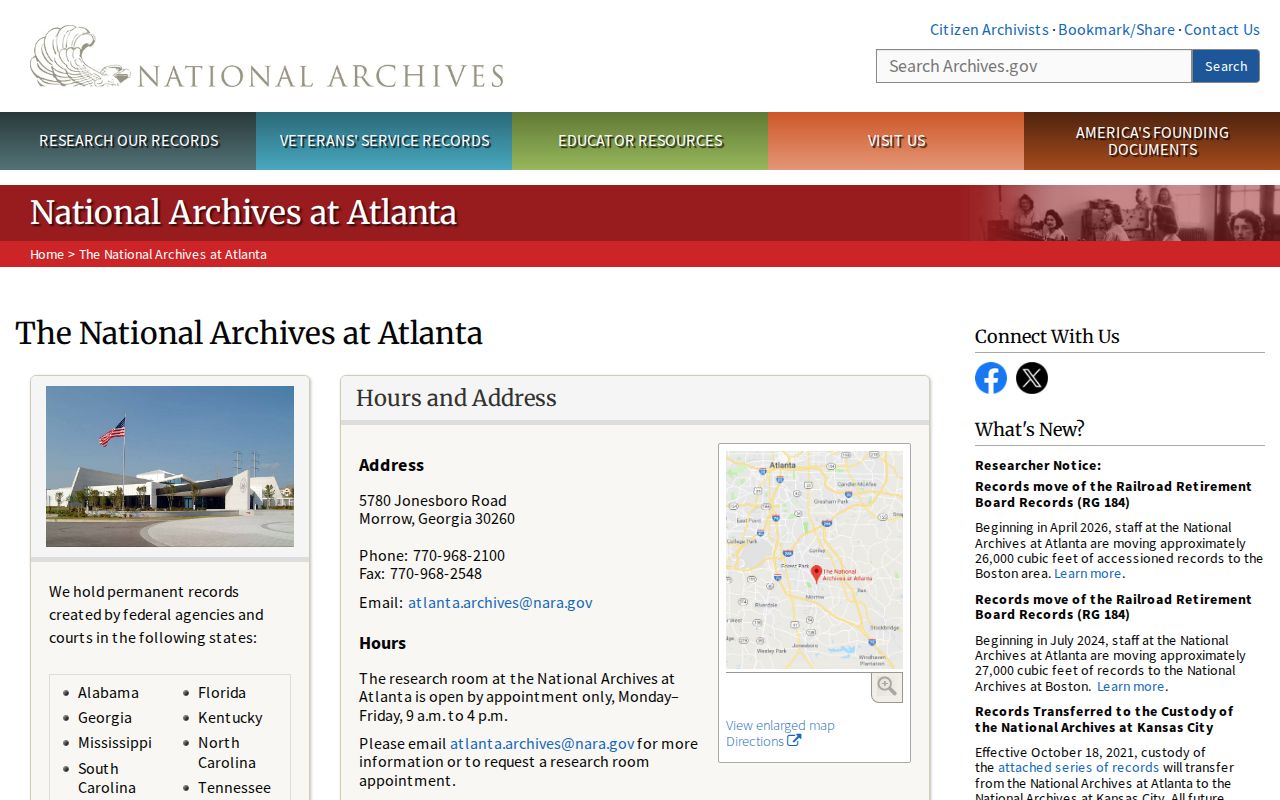
Treat county, state, and federal holdings as distinct catalogs. Search each one separately, even though all three sit within reach of Clayton County.
Protecting Clayton Resident Addresses
Georgia VoteSafe shields the residence addresses of qualifying voters. Georgia added a broader victim-centered program under O.C.G.A. Title 50, Chapter 18, Article 4. Suppression like this exists for safety. Never try to defeat it by piecing together parcel, voter, court, or commercial data.
Errors go back to the custodian who created the record. The assessor fixes parcel data, elections staff handle voter rolls, the clerk corrects indexing errors, and a licensing board manages a license profile. A downstream residents directory cannot amend the official source.
Lawful use. Clayton County records support family history, estate work, civic review, and personal safety, never stalking, harassment, or evasion of protected-address rules.
Historical Clayton County Resident Directories
Clayton's printed directory record is spotty and metro-oriented. Confirmed leads include a 1960 Forest Park directory. It also includes regional telephone books from 1968 and 1970. Those may capture Ellenwood and Conley contexts. A 1997 repository description from the Clayton County Library System noted a Genealogy and Local History Room at Headquarters in Jonesboro. Current access and exact holdings should be confirmed with the library. UGA, the Digital Library of Georgia, Georgia Archives, and the Library of Congress each run their own catalogs. Those are worth checking.
A city directory entry can list a householder, spouse, occupation, employer, street address, or an owner/renter mark. A criss-cross directory flips that arrangement. Give a street and house number, and it leads to the listed occupant. That makes it a handy street directory for tracing past residents of Clayton County. The Clayton County city directory covers the full collection and how to read it. Before 1858, follow Henry and Fayette County indexes instead, because Clayton did not yet exist.
- Roll
- An official list created for a set purpose, such as taxation or voting.
- Index
- A finding aid that points to a record; it is not always the record image.
- Parcel
- A mapped unit of land identified by the assessor.
- Criss-cross directory
- A directory arranged by street and address instead of surname.